BRAP is pleased to announce the call for applications for the Workshop on Establishing Biosecurity Measures in Zamboanga Peninsula this October 2023!
This project is a BRAP-led, fully funded project by the US Department of State Biosecurity Engagement Program, administered by Health Security Partners and co-organized by the BioRisk Association of the Philippines 2015, Inc., in partnership with Western Mindanao State University.
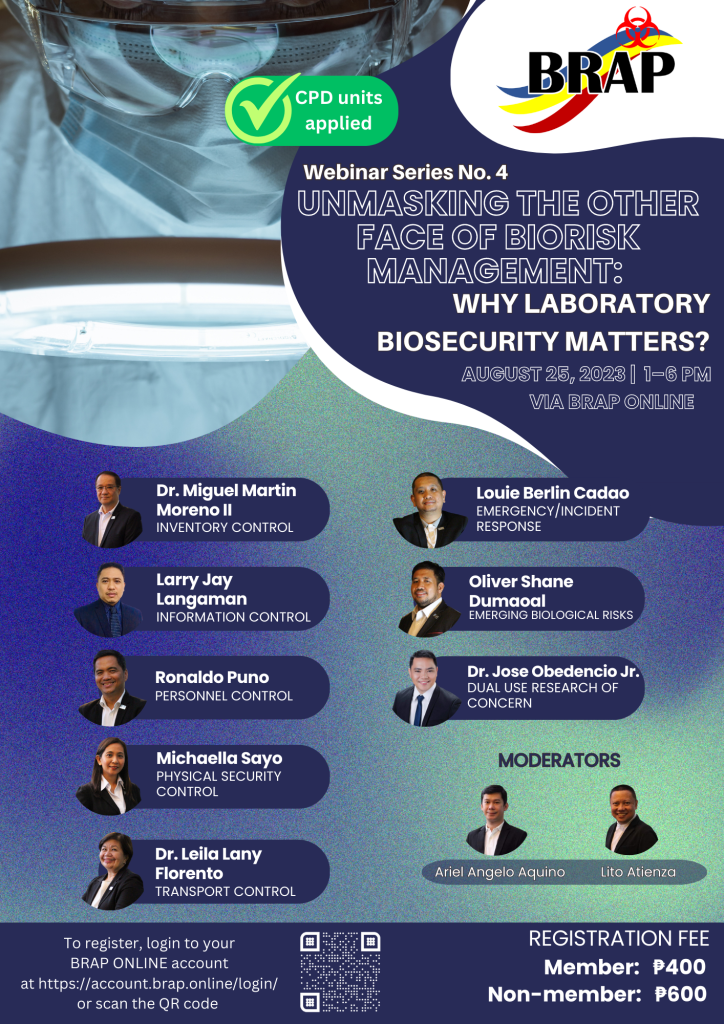
BRAP is inviting everyone to join “Webinar Series No. 4: Unmasking the Other Face of Biorisk Management: Why Laboratory Security Matters?” on August 25, 2023, from 1 PM to 6 PM, via Zoom, accessible through your BRAP ONLINE account.
Course description:
The 5-hour webinar will focus on the eight pillars of laboratory biosecurity in reference with the 4th edition of WHO Laboratory Biosafety Manual. Laboratory biosecurity refers to institutional and personnel security measures designed to prevent the loss, theft, misuse, diversion or unintentional release of biological agents being handled in the laboratory. Addressing laboratory biosecurity risks in many ways parallels and complements that of biosafety risk management. Effective biosafety practices are the foundation of laboratory biosecurity, and biosecurity risk control measures must be performed as an integral part of an institution’s biosafety program management.
To register, create or log in to your BRAP ONLINE account at https://brap.online
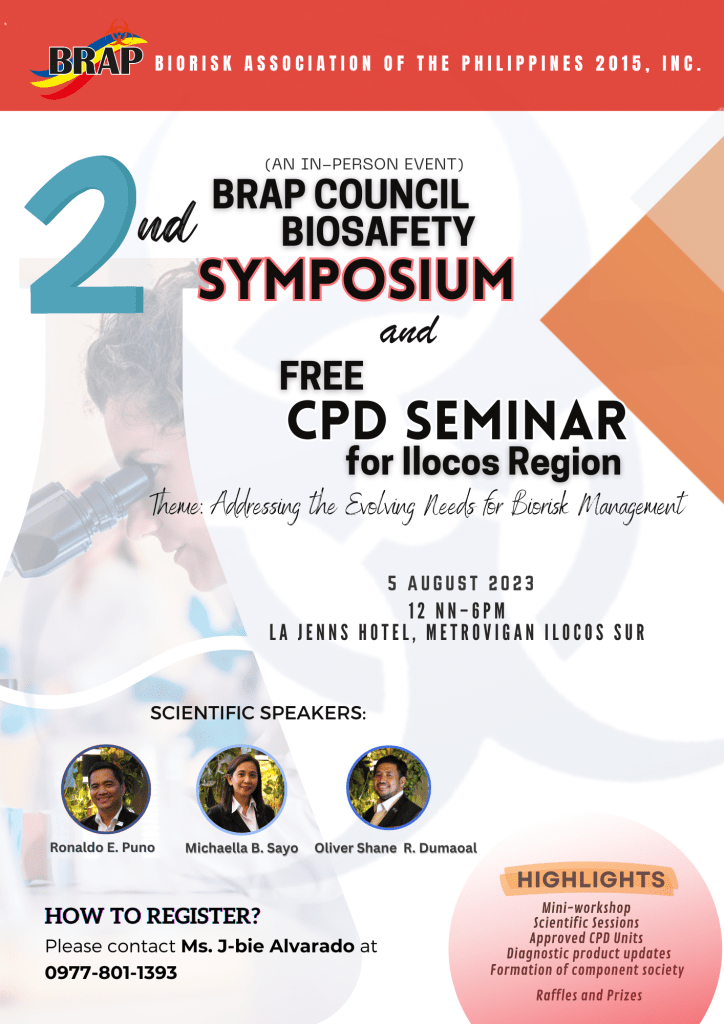
BRAP would like to invite you to join the 2nd BRAP Council Biosafety Symposium and Free CPD Seminar for Ilocos Region, with the theme “Addressing the Evolving Needs for Biorisk Management”, on August 5, 2023, at La Jenns Hotel in Metro Vigan Ilocos Sur, from 12 NN to 6 PM.
To register, please contact the pointperson indicated in the flyer.
Course description:
This 4-hour training/workshop will address the country’s biorisk management needs, particularly for those who work in biocontainment facilities.
The increased demand for improved disease detection and control has increased diagnostic and research capacity. Increases in infectious disease detection capacity, on the other hand, have not always been accompanied by increases in biosafety and biosecurity capacity, particularly in low-resource countries. Numerous obstacles impede the development or expansion of sustainable capacity in low-resource countries for biosafety and biosecurity management.
Using the WHO checklist, each participant will identify different gaps in the Biosafety program. Long-term capacity development solutions must be identified, funded, and implemented collaboratively. A collaborative effort is required to develop solutions that are appropriate for the specific needs and resources available in the institution.






 BioRisk Association of the Philippines 2015, Inc. (BRAP2015)