Train the Trainers Workshop

Biological Risk Association Philippines‘s Train the Trainers Workshop, in partnership with the US Department of State Biosecurity Engagement Program (BEP) and CRDF Global, was successfully concluded last August 23, 2016. The participants who were handpicked by the BRAP and the BEP were either with the academe or in the laboratory who have a knack in giving lectures about biosafety and biosecurity. They were housed for 2 days at the Marriott Hotel in Manila. The participants came from different institutions all over the Philippines so that dissemination of information about biosafety and biosecurity is scattered throughout the country.

IMG_0319.JPG

Train the Trainers participants, speaker, and evaluators

The first day of the workshop kicked off by introduction of the participants, in which they have to introduce themselves by giving their name, institution, position, number of years working in the institution, and their distinct tag, in which other participants could easily remember them.
FB_IMG_1472600418189

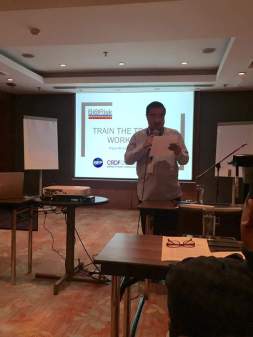
Dr. Moreno spearheaded the workshop

The driving force behind the workshop was no other than Dr. Miguel Martin N. Moreno II, BRAP President, and Biosafety Officer of both St. Luke’s Medical Center in the Quezon City and Global City.

The first day was slated for lecture proper. The topics were diverse and were useful in training: having clear objectives, knowing your stuff and audience, using your tools appropriately, and developing stage presence. Dr. Moreno also taught the TTT participants how to dispel their public speaking demons and to develop their own metrics. He also discussed the checklist that is needed for effective training slide presentations. Later in the day, all participants were paired, and each pair was assigned each topic regarding biosafety and biosecurity, which the participants would present the next day.

Now it was the participants’ time to strut their stuff on the second day. In one of the topics from the first day was that they have to defy their fears in speaking publicly, so Dr Moreno made them present their assignments in front of the other participants, applying what they have learned from the first day and applying their own techniques. We invited two evaluators, Dr. Socorro Lupisan, Director of Research Institute for Tropical Medicine (RITM), and Mr. Ian Medina, Senior Science Research Specialist from RITM, and both were PhABOT graduates. For every pair, the evaluators commented on their style, do’s and don’ts, what could be changed and enhanced. It was a tiring day for everyone, but very informative and fruitful.

FB_IMG_1472599376544

TTT Participants


Posted in News and Updates | 1 Comment

Meeting with the Program Adviser-BEP

From L-R: Velasco, Goode, Ogatis, Haq and Moreno.

In attendance: Velasco, Goode, Ogatis, Haq and Moreno.

A Meeting to Kickoff Future Collaborations

The meeting was attended by the Biological Risk Association Philippines (BRAP) president Dr. Miguel Martin N. Moreno II and vice president Dr. John Mark S. Velasco with Biosecurity Engagement Program (BEP) outgoing Program Adviser Brett Goode and incoming Mde. Amal Haq, accompanied by Ms. Ma. Sol Ogatis from the Export Control and Border Security Program of BEP at the US Embassy in Manila. Discussions revolved on BRAP founding, what BRAP has achieved in just a few months of existence, and future collaborations with BEP. The meeting was a simple acquaintance meet-up and a getting to know each other and each other’s institutions. Mde. Haq reiterated that BRAP has the support of BEP and applications for grants are welcome as long as proper procedures are followed. The meeting was held at the Tomato Grill in St. Luke’s Medical Center in Quezon City, just within the vicinity of the official residence of BRAP office.

All About BEP

bep-logo

The Biosecurity Engagement Program (BEP) was first funded in FY 2006 and is part of the Nonproliferation, Anti-Terrorism, Demining and Related Programs Global Threat Reduction programs account managed and implemented by the U.S. Department of State Bureau of International Security and Nonproliferation Office of Cooperative Threat Reduction (ISN/CTR). The BEP mission is to engage life scientists and to combat biological threats worldwide by providing assistance to improve biosecurity, biosafety, pathogen surveillance, and infectious disease surveillance and response. In fulfilling its mission, BEP seeks to guide its efforts based on the  National Strategy for Countering Biological Threats (PPD-2), which builds upon the National Biodefense Strategy (HSPD-10/NSPD-33), as well as international guidance from the Biological and Toxin Weapons Convention and United Nations Security Council Resolution 1540.

Over the past seven years, BEP has expanded its scope of work, countries of engagement, and funding commitment. In every country in which BEP is engaged, the long-term goal of our programmatic activities is to work with governments and other stakeholders to build sustainable capacity for biosecurity, biosafety, disease surveillance, and scientific inquiry. To assess our success, we are working with collaborators to develop metrics that will enable assessment of not only the nature and extent of our engagement, but also the sustainability of the programs and capacities that we are introducing. (From https://www.bepstate.net/about-us/).

Posted in News and Updates | 2 Comments

New Risk Group Database App

ABSA logo2


Risk Group Database App

FREE for iTunes and Android!
ABSA Risk Group App screenshot1

ABSA Risk Group App screenshot2

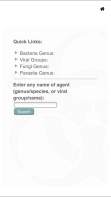
ABSA International created an app for the ABSA Risk Group Database, which is available for Apple and Android devices. The app will allow users to access the ABSA Risk Group Database on their mobile devices.

The ABSA Risk Group Database consists of international risk group classifications for Bacteria, Viruses, Fungi, and Parasites. In many countries, including the United States, infectious agents are categorized in risk groups based on their relative risk. Depending on the country and/or organization, this classification system might take the following factors into consideration: pathogenicity of the organism; mode of transmission and host range; availability of effective preventive measures (e.g., vaccines); availability of effective treatment (e.g., antibiotics); and other factors.
iPhone and iPad Instructions:
You can download the Risk Group Database app in the Apple iTunes store by searching for “Risk Group Database app.”
Android Instructions:
You can download the Risk Group Database app in the Google Play Store by searching for “Risk Group Database.”
NOTE: The app only works when your device is connected to the internet.
Please send any comments or suggestions about the app to info@absa.org. An update is being planned for early October.
ABSA International would like to express our sincere gratitude to the fellows at the National Biosafety and Biocontainment Program (NBBTP) for updating the ABSA Risk Group Database.
Reposted from: http://www.absa.org/
Posted in News and Updates | Leave a comment