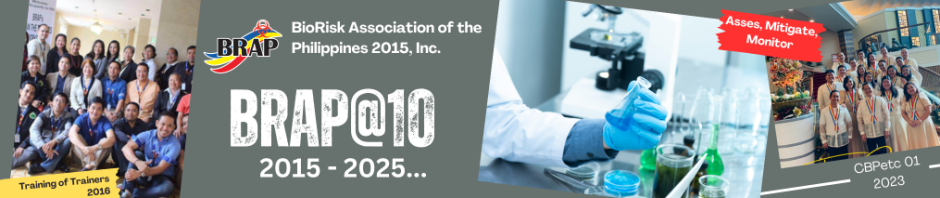
The BioRisk Association of the Philippines 2015, Inc. (BRAP) proudly invites you to the second webinar of our BRAP Webinar Series 2025, “Net on Board”, featuring the BRAP Component Society for the National Capital Region (NCR).
Laboratory Resilience: Bridging Safety Standards and Biopreparedness for Effective Incident Management
Date: February 25, 2025 (Tuesday)
Time: 1:00 PM–6:00 PM
via BRAP ONLINE

Synthesis
By Mr. Larry Jay Langaman
The webinar provided a comprehensive discussion on biosafety, biosecurity, and bioriskmanagement, equipping participants with actionable strategies to enhance laboratory resilience and emergency preparedness. The three expert-led sessions underscored the need for harmonized safety standards, strategic risk management, and emergency response preparedness in laboratories and healthcare facilities. Below are the key takeaways and actionable insights of the 3 presentations delivered by BRAP’s subject matter experts (SMEs).
1. How to Align DOH Biosafety and Biosecurity Standards and Guidelines with International Standards. Speaker: Miguel Martin N. Moreno II, MD, CBP, IFBA PC, CLSSYB
• The Philippine’s national biosafety and biosecurity standards issued by the Department of Health (DOH) is aligned with international references such as WHO LBM4 and ISO 35001; what we need is interagency collaboration for sustained implementation.
• Standard gets improved; so as our local guidelines. There is pressing need to implement continuous education and training programs to ensure that personnel at all levels stay updated on evolving standards.
• Being mostly on the frontline, laboratorians need to encourage healthcare administration to take an active role in policy execution, stakeholder coordination, and monitoring compliance for biosafety, biosecurity, and biorisk management
2. Bridging the Gaps in Biorisk Management in Healthcare Facilities. Speaker: Ronaldo E. Puno, RMT, MBA-H, CPB, IFBA PC
• Risk assessment is one critical act that exposes the gap when managing biological risks.
• Gaps includes knowledge, procedure, resources, communication, training, monitoring & surveillance.
• DOH Risk assessment framework is harmonized with international references because footprints are found in our local guidelines
• Utilize risk assessment frameworks to improve response to biological threats and prepare better for emergencies.
• Foster a culture of safety through enhanced interdepartmental communication and integration of real-time monitoring systems.
• Advocate for better resource allocation and infrastructure improvements to strengthen healthcare resilience against biological hazards.
3. Medical Laboratory Emergencies, how prepared are you? Speaker: Jocelyn S. Aquisay, RMT, CBO, IFBA PC
• Make safety a routine activity; integrate safety steps in the laboratory procedure.
• Conduct regular risk assessments to identify and prioritize laboratory hazards.
• Establish and practice emergency response plans, including training on incident response, first aid, and evacuation procedures.
• Ensure the proper use and availability of protective and safety equipment to mitigate risks.
• Implement effective communication protocols, such as emergency call trees and post-incident reporting mechanisms, to improve response coordination.
The SMEs reconvened during the engaging panel discussion with the participants as they expressed insightful perspectives on global biorisk management standards; its footprints to national guidelines, practical and creative ways in implementing these guidelines at institutional level, plus experiential and candid thoughts on AI-driven risk assessments, legal impediments, and biosafety advocacy ministerial acts.
The webinar reinforced the importance of a proactive and integrated approach to laboratory resilience, emphasizing collaboration, continuous learning, and institutional commitment to safety. The participants parted the session bringing with them encouragement to apply theabove insights within their respective institutions to bridge safety gaps, enhance biopreparedness, and build a robust, secure, and adaptive laboratory environment capable of responding effectively to emerging threats.




 BioRisk Association of the Philippines 2015, Inc. (BRAP2015)