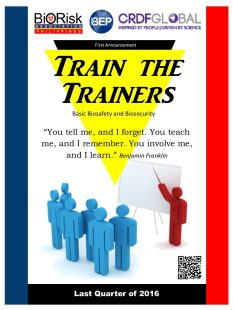
 “It’s not enough to train the workforce, you also have to train the trainer.” (mmnMoreno)
Train the Trainers (TTT) is a BRAP-led 2-day live-in workshop in partnership with the US Department of State Biosecurity Engagement Program and the Civilian Research Development (BEP) and the Civilian Research Development Fund (CRDF) Global.
TTT is also for those trainers who need a refresher to improve their classroom techniques and methods to transfer learning to work situations. The workshop is scheduled on August 22-23, 2016 at the Marriot Hotel Pasay City , Paranaque, MM.
Below are the successful applicants to the TTT. Successful applicants need to confirm attendance with BRAP Asst. Secretary Mr. Ariel Aquino at (bioriskassociationphilippines@gmail.com) for further processing of travel and hotel accommodations.
CONGRATULATIONS and looking forward to a great learning experience with you at the TTT.
North
Luzon |
Almira |
Abrazado |
Philippine Red Cross, La Union Chapter, San Fernando City, La Union |
| Perlita |
Bautista |
City Health Office, Santiago City, Isabela |
| Maryann |
Cumigad |
Clinica Caritas, Tuguegarao Branch, Cagayan |
| Michelle |
Sayo |
Bulacan Medical Center, Malolos, Bulacan |
| Aldrin |
Tumamao |
Northwestern University, Laoag City, Ilocos Norte |
| Ralleigh |
Vizcarra |
University of La Salette, Inc., Santiago City, Isabela |
| National Capital Region |
Pia Marie |
Albano |
Research Center for the Natural and Applied Sciences, UST |
| Louie Berlin |
Cadao |
St. Luke’s Medical Center – Global City |
| Leila |
Florento |
United Laboratories, Mandaluyong, MM |
| Gamaliel |
Fulgueras |
Veterans Memorial Medical Center, QC |
| Fidelino Jr. |
Malbas |
Research Institute for Tropical Medicine, Alabang |
| Gina |
Noble |
Delgado Medical Center, Quezon City |
| Ronaldo |
Puno |
Lyceum of the Philippines, PAMET |
| Orlando |
Ruiz |
Makati Medical Center, Makati City |
| Rommel |
Saceda |
St. Luke’s Medical Center – Quezon City |
| Demetrio |
Valle |
Ospital ng Makati, Makati City |
| Luella |
Vertucio |
Providence Hospital, Quezon City |
| South Luzon |
Rexy |
Alvarez |
Bicol Medical Center, Naga City, Camarines Sur |
| Oliver Shane |
Dumaoal |
Lyceum of the Philippines University – Batangas City |
| Sierra Roma |
Hernandez |
Southern Luzon Medical Center, Bacoor, Cavite |
| Melvin |
Toca |
Bicol Regional Training and Teaching Hospital, Legaspi City, Albay |
| Visayas |
Fredeswinda |
Cortes |
Center for Health Services, Mandaue City, CEbu |
| Mindanao |
Larry Jay |
Langaman |
Davao Doctors Hospital, Davao City, Davao |
| Richard |
Tabuniag |
Zamboanga City Medical Center, Zamboanga |
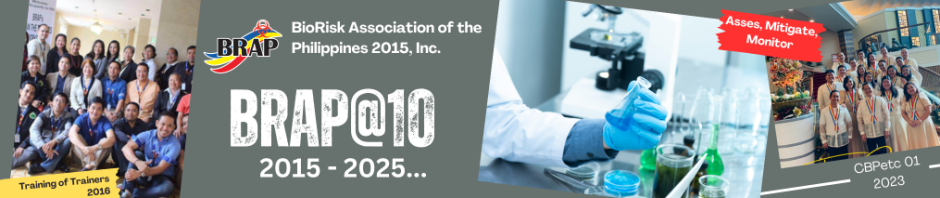
 The National Biological Materials of Concern (BMC) “Write-Shop” is a two-day event hosted by the Biological Risk Association Philippines (BRAP) in partnership with the U.S. Defense Threat Reduction Agency (DTRA) Cooperative Biological Engagement Program (CBEP) that will take place 16-17 August 2016, in Manila, Philippines. (Click document to see entire pdf)