Theme: “Shared Leadership for Safe, Secure, and Resilient BSL-2 Hospital Operations”, “Because biosafety is not only a laboratory practice – it is a hospital leadership commitment.”
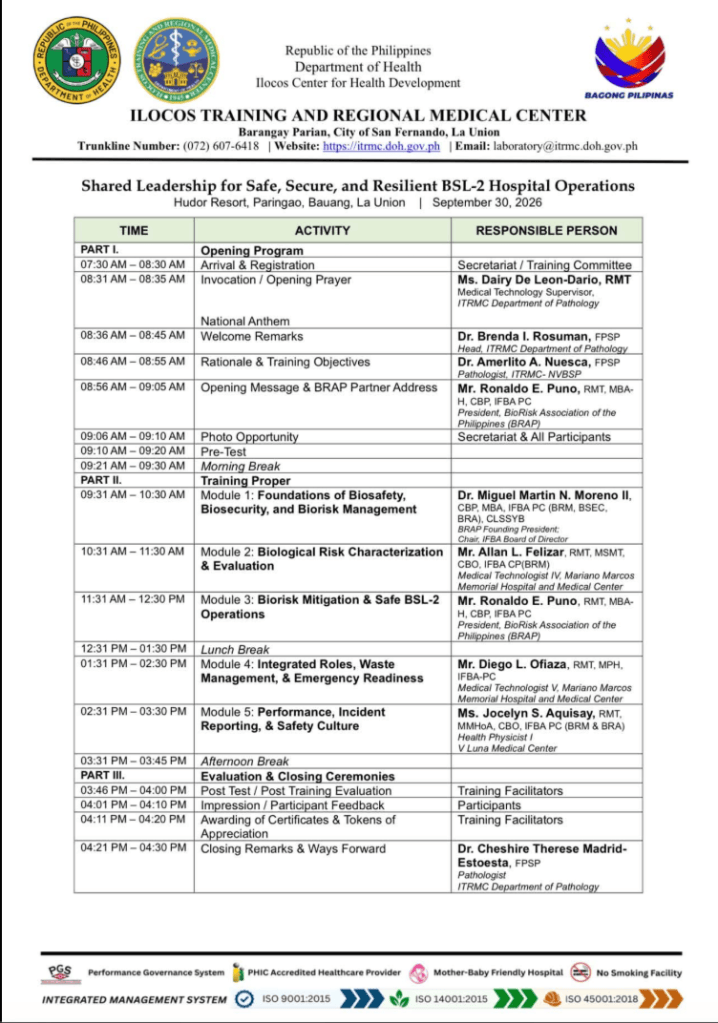
Training Date: September 30, 2026
Training Venue: Hudor Resort, La Union
Target Participants: Physicians, Medical Technologists, Nurses (IPCU/PHU), Biomedical Engineers, Safety Officers, Pollution Control Officers
Lectures:
1. Foundations of Biosafety, Biosecurity, and Biorisk Management by Dr. Miguel Martin N. Moreno II
This topic is included to provide hospital leaders with a common understanding of the basic principles that govern safe and secure BSL-2 facility operations. Since biosafety, biosecurity, and biorisk management are often viewed as purely technical laboratory concerns, this session reframes them as institutional responsibilities that affect patient safety, healthcare worker protection, service continuity, public health surveillance, and environmental safety.
For hospital leaders, understanding these foundations is essential because leadership decisions influence staffing, resources, infrastructure, workflow, training, compliance, and accountability. This topic establishes the mindset that biological risk must be anticipated, assessed, controlled, monitored, and continuously improved through a coordinated hospital-wide system.
2. Biological Risk Characterization and Evaluation in Hospital Operations by Mr. Allan L. Fellizar
This topic is included to help hospital leaders understand how biological risks are identified, analyzed, prioritized, and evaluated within healthcare operations. BSL-2 facilities handle specimens and activities that may involve infectious materials, exposure hazards, equipment-related risks, waste risks, facility risks, and emergency scenarios. Without proper risk characterization, leaders may underestimate hazards or allocate resources to less critical areas.
Risk characterization helps identify the factors that contribute to risk, including the biological agent, procedure, personnel involved, route of exposure, facility condition, equipment reliability, workflow, and existing controls. Risk evaluation then helps determine whether the risk is acceptable or whether additional mitigation is required. For leaders, this topic supports better decision-making, prioritization, resource allocation, and institutional accountability.
3. Biorisk Mitigation and Safe BSL-2 Building Operations by Mr. Ronaldo E. Puno
This topic is included to translate risk assessment into practical control measures that keep the BSL-2 facility safe, functional, and compliant. Hospital leaders need to understand that safe BSL-2 operations depend not only on laboratory practices but also on building design, access control, ventilation, biosafety cabinets, equipment maintenance, waste routes, emergency systems, decontamination processes, and clear operational policies.
Biorisk mitigation ensures that identified risks are reduced through engineering controls, administrative controls, safe work practices, proper PPE, regular maintenance, competency-based training, and monitoring. This topic is important for leaders because many mitigation measures require management support, budget allocation, interdepartmental coordination, and sustained supervision.
4. Integrated Roles, Waste Management, Environmental Safety, and Emergency Readiness by Mr. Diego L. Ofiaza
This topic is included to emphasize that BSL-2 operations require coordination across multiple hospital units. Biological safety is affected by the work of physicians, nurses, medical technologists, biomedical engineers, infection prevention personnel, pollution control officers, safety officers, housekeeping staff, security personnel, and administrators. If roles are unclear, gaps may occur in specimen handling, waste flow, spill response, exposure management, equipment maintenance, and emergency communication. The inclusion of waste management and environmental safety highlights the responsibility of the hospital to prevent contamination, protect workers, comply with environmental requirements, and ensure the safe movement, storage, treatment, and disposal of infectious waste. Emergency readiness is also essential because spills, exposure incidents, equipment failure, ventilation problems, power interruptions, and outbreak surges require coordinated and timely action. This topic promotes shared accountability and operational preparedness.
5. Biorisk Management System Performance, Incident Reporting, and Safety Culture by Ms. Jocelyn S. Aquisay
This topic is included to help hospital leaders understand how BSL-2 safety is sustained over time. A BSL-2 facility cannot depend only on written policies or one-time training. Its performance must be monitored through documentation, audits, incident reports, corrective actions, preventive actions, competency assessment, maintenance records, waste records, exposure reports, and management review.
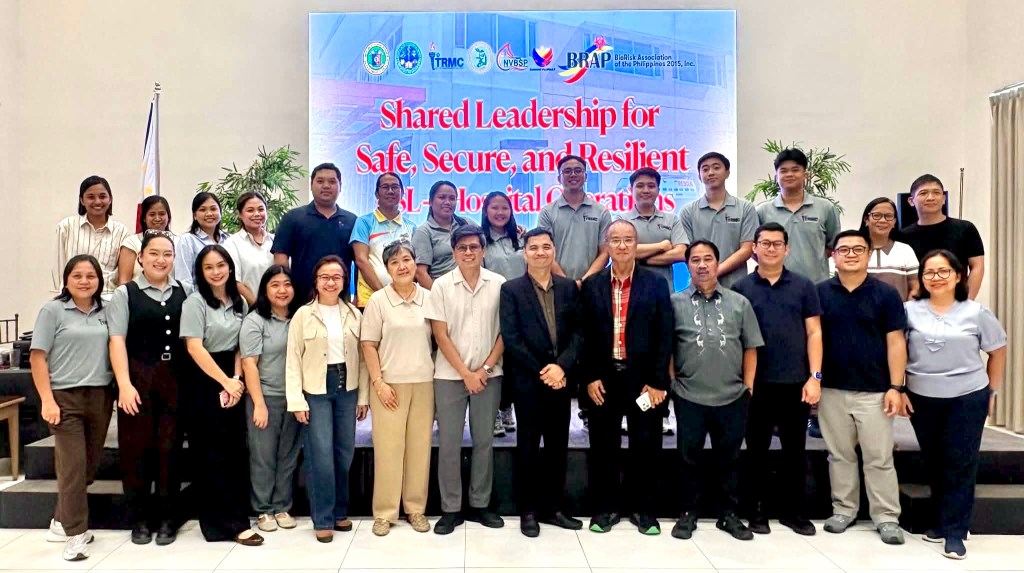
Thank you to Dr. Wilson Laranang for the invitation, organizing the event and warm hospitality., and to the Organizing committee of the event, maraming salamat po.