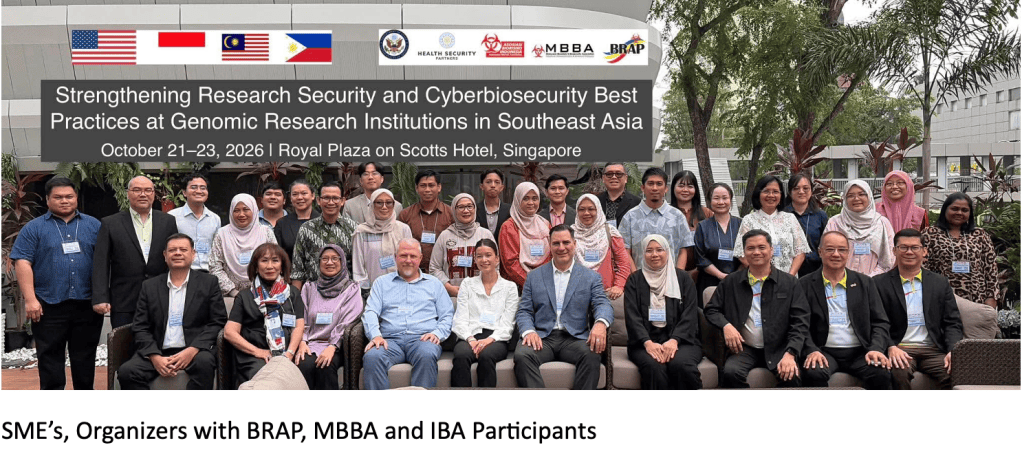
Strengthening Know-Your-Collaborator and Cyberbiosecurity Policies and Best Practices at Genomic Research Institutions in Southeast Asia
October 21-23, 2026
Royal Plaza on Scotts, Singapore
Executive Summary
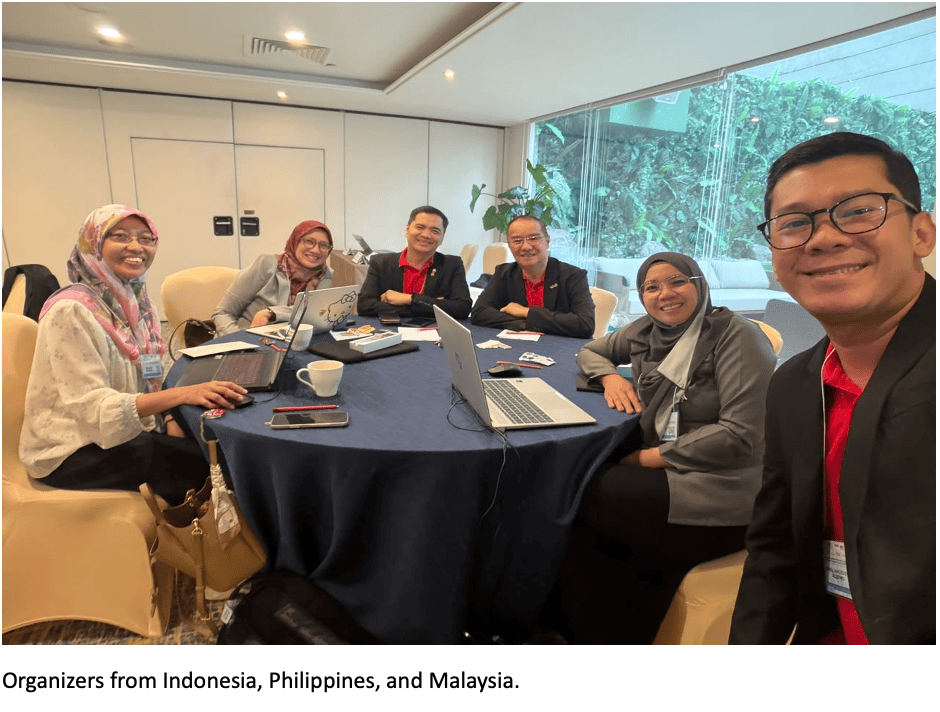
The project, Strengthening Know-Your-Collaborator and Cyberbiosecurity Policies and Best Practices at Genomic Research Institutions in Southeast Asia, was designed to safeguard sensitive genomic data and strengthen the security of research collaborations. The initiative brings together Health Security Partners (HSP), the BioRisk Association of the Philippines 2015, Inc. (BRAP), the Indonesian Biorisk Association, and the Malaysian Biosafety and Biosecurity Association.
The project framework includes a three-day regional workshop for approximately 30 researchers, IT professionals, and administrators from the Philippines, Indonesia, and Malaysia. A pre-workshop risk survey is intended to guide training on Know-Your-Collaborator practices, cybersecurity, and data governance. Follow-on mentorship and targeted security assistance are planned for at least six institutions to support the review and strengthening of institutional standard operating procedures. This project was fully-funded by the U.S. Depqrtment of State, Biosecurity Engagement Program – Cooperative Threat Reduction.
BRAP’s role encompasses participant coordination, curriculum development support, workshop logistics, attendance monitoring, and technical and financial reporting to HSP. Through regional training and institutional support, the initiative aims to build sustainable capacity for protecting genomic research and managing collaboration-related security risks across Southeast Asia.
Participant’s Recruitment
The US Department of State’s Cooperative Threat Reduction (CTR) Biosecurity Engagement Program (BEP) requested that BRAP invite paired representatives—a laboratory professional and an IT practitioner supporting laboratory operations—from institutions engaged in genomic research. The CTR-identified institutions were the Department of Science and Technology, the Philippine Genome Center, the University of the Philippines–National Institutes of Health, and the Research Institute for Tropical Medicine. BRAP also requested the inclusion of the Research Division of St. Luke’s Medical Center in Quezon City because of its pioneering involvement in genomic research which started many years back.
With only 10 participant slots available, BRAP developed an assessment tool to guide applicant interviews and rank candidates according to their suitability for the project. BRAP then submitted its recommended participants to CTR for final approval.
Final Philippine Participants List
| Name | Institution |
| Dr. Rommel Gestuveo | Dept. of Science and Technology – ITDI |
| Dr. Mark Pierre Dimamay | St. Luke’s Medical Center – Research |
| Ms. Ma. Celeste Abad | Philippine Genome Center |
| Mr. El King Morado | Philippine Genome Center |
| Mr. Sunny Lamasa | Research Institute for Tropical Medicine |
| Dr. John Mark Velasco | UP-National Institute of Health |
| Mr. Eric Manuel Pareja | UP-National Institute of Health |
| Mr. Ronaldo Puno | Prolab Diagnostics / BRAP National President |
| Dr. Miguel Martin Moreno II | BRAP Committee on Special Projects Chair / Project Lead |
| Mr. Ariel Angelo Aquino | BRAP National Secretary / Project Organizer |
Synopsis
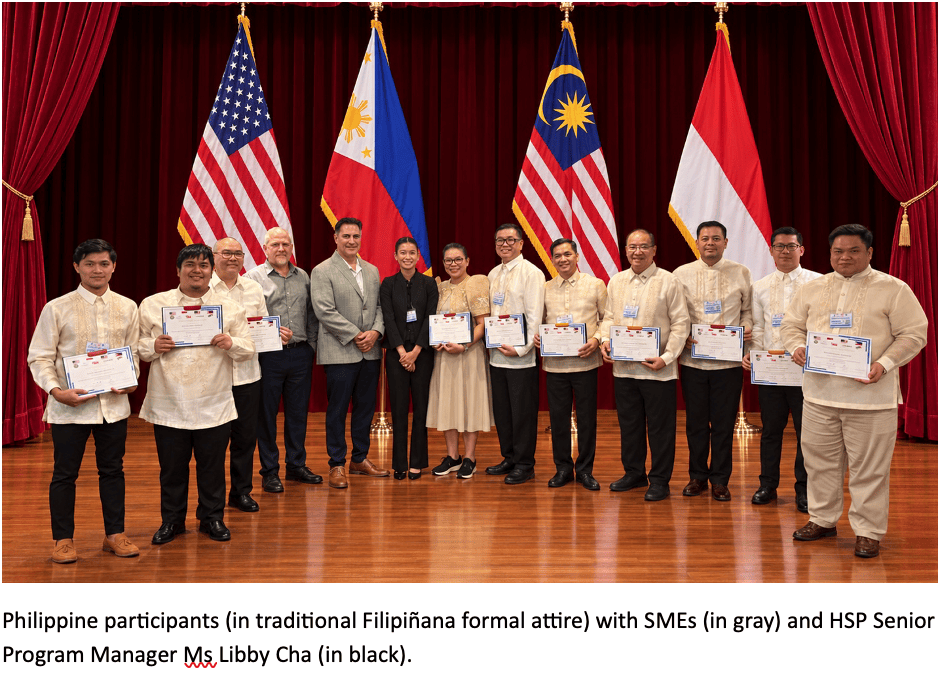
The three-day workshop addressed the protection of genomic research and international collaborations through integrated Know-Your-Collaborator (KYC), cyberbiosecurity, and data-governance practices. Health Security Partners introduced the program’s objectives and regional partnerships, while GeneInfoSec facilitators Chris Detter and Aaron Hansen guided participants through presentations, case assessments, policy reviews, and practical exercises. Day 1 examined the genomic research landscape in Southeast Asia, partner vetting, due diligence, and safeguards in Material and Data Transfer Agreements, with participants mapping collaboration review processes and identifying appropriate agreement controls. Day 2 focused on monitoring ongoing collaborations, recognizing insider threats, assessing whole-genome sequencing and dual-use research risks, including sequence-based modeling, and classifying sensitive genomic assets. Participants applied these concepts through scenario-based assessments and risk registers that documented safeguards, responsibilities, and conditions requiring further review. Day 3 addressed cybersecurity threats, institutional policies, cyber-hygiene, and the capabilities and limitations of AI-enabled intrusion detection, followed by a tabletop exercise on coordinated incident response. Institutions then consolidated their workshop outputs into proposed improvements to priority KYC, cybersecurity, or data-governance standard operating procedures, establishing a basis for continued refinement through HSP’s follow-on security assistance and mentorship. The workshop concluded with a post-test, certificate presentation, and closing discussion on sustaining institutional action and regional cooperation.
Overall Impact of the Workshop
The workshop brought together laboratory, IT, and institutional representatives from the Philippines, Indonesia, and Malaysia to integrate KYC, dual-use risk assessment, cybersecurity, and data governance into research collaboration oversight. Practical exercises produced review workflows, risk registers, agreement safeguards, and proposed SOP improvements, while strengthening regional cooperation. These outputs established a foundation for institutional implementation through follow-on mentorship.
Way Forward for BRAP
BRAP will work with HSP and regional partners to help Philippine institutions refine and implement priority SOPs on KYC, cybersecurity, and genomic data governance. Through mentorship and security assistance, BRAP will encourage shared laboratory and IT leadership, establish implementation milestones, and monitor institutional adoption. Continued regional exchange will support practical improvements and sustained protection of genomic research.
Acknowledgements
We extend our sincere gratitude to the U.S. Department of State’s Cooperative Threat Reduction Biosecurity Engagement Program for its invaluable support of this regional initiative. We gratefully acknowledge Health Security Partners, particularly Dr. Jason Rao, Dr. Prasad Kuduvalli, Program Manager Ms Erin Fink, and Senior Program Manager Ms Libby Cha, for their leadership, guidance, and dedicated coordination. We also express our deep appreciation to Ms. Faizatul Lela Jafar of the Malaysian Biosafety and Biosecurity Association; Dr. Diah Iskandriati of the Indonesian Biorisk Association; and Mr. Ronnie Puno, Mr. Ariel Angelo Aquino, and Dr. Martin Moreno, Philippine Project Lead, of the BioRisk Association of the Philippines. Their collective commitment, expertise, and collaboration were instrumental in supporting the workshop and advancing the shared goal of strengthening genomic research security in Southeast Asia.
End of document.
261025