Official list of participants to the Strengthening Safe and Secure Practices for Specimen Handling, Packaging and Transport: Phase 2
Congratulations!  See you all in Clark, Pampanga!

Official list of participants to the Strengthening Safe and Secure Practices for Specimen Handling, Packaging and Transport: Phase 2
Congratulations! See you all in Clark, Pampanga!


Background:
Cross-sectional surveys conducted by HSP partners at the BioRisk Association of the Philippines (BRAP2015) revealed that biosecurity implementation is a key biorisk management gap at high-risk laboratories in the Philippines. In addition, new international biorisk management standards (ISO 35001:2019) and the WHO Biosafety Manual 4th Edition require robust biosecurity risk assessments as part of implementation and compliance. Taken together, there is an urgent need to train biorisk professionals in how to conduct proper biosecurity risk assessments and develop mitigation measures for their institutions, as the first critical step to implementing biosecurity. In partnership with BRAP, HSP will deliver a series of biosecurity risk assessment and mitigation trainings and mentorship to a cohort of biorisk officers at high-risk laboratories.
Scope and Format: This workshop will train at least 12 biorisk officers from high-risk institutions. All participants will be alumni of the Philippines Advanced Biorisk Officers Training (PhABOT) and will be overseen by BRAP throughout the course, as to develop a new cohort of BRAP-certified trainers equipped with the knowledge and skills to propagate this training at their home institutions. Participants will complete a training that will be delivered in three key phases using a blended approach:
Following the training, HSP will support the cohort of trainers in taking the IFBA exam for certification in Risk Assessment. In addition, HSP will utilize the risk assessment and mitigation plans developed by the trainers to brief key government agencies on current vulnerabilities and biosecurity solutions at high-risk labs in the country.
Objectives: The primary objective of this project is to enable a cohort of trainers to implement best practices and enhance biosecurity risk assessment and mitigation at their home institutions
Impact: Through the train-the-trainer approach and continued mentorship to the cohort of trainers, this program will have a direct impact for securing laboratories in the Philippines. Additionally, IFBA certification and recommendations made to relevant government agencies will have a sustained impact on this sector.
Funding grant: This project is fully funded by the US Department of State Biosecurity Engagement Program, administered by Health Securities Partners (HSP) and overseen by the BioRisk Association of the Philippines 2015, Inc.(BRAP2015).

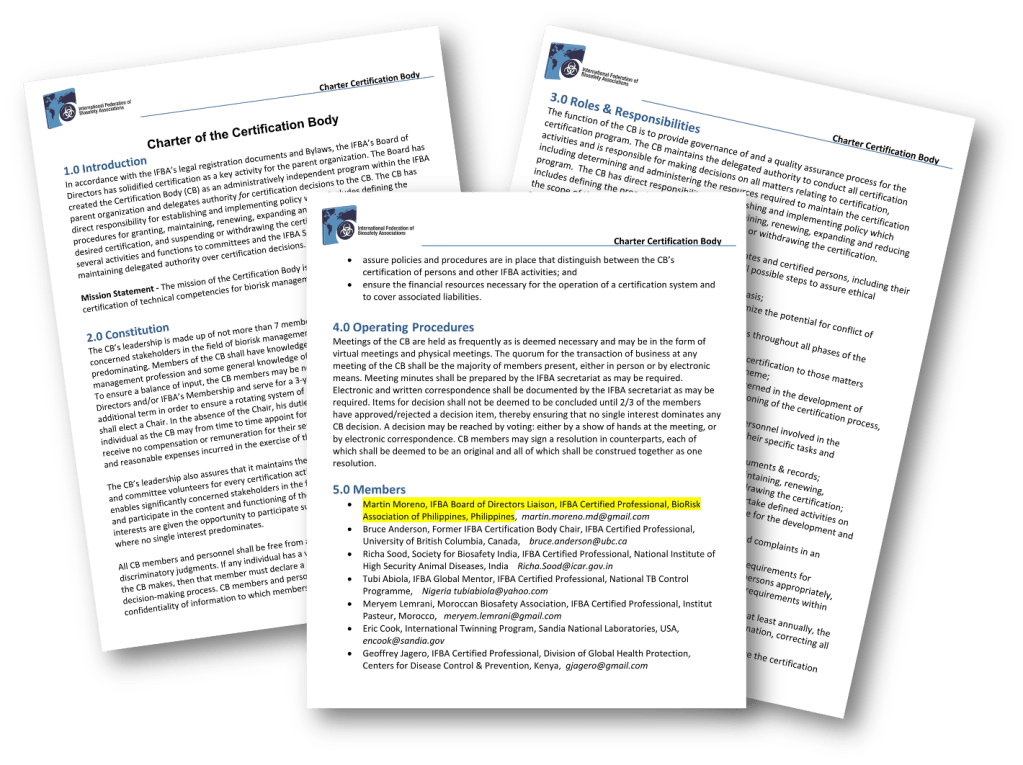
In accordance with the IFBA’s legal registration documents and Bylaws, the IFBA’s Board of Directors has solidified certification as a key activity for the parent organization. The Board has created the Certification Body (CB) as an administratively independent program within the IFBA parent organization and delegates authority for certification decisions to the CB. The CB has direct responsibility for establishing and implementing policy which includes defining the procedures for granting, maintaining, renewing, expanding and reducing the scope of the desired certification, and suspending or withdrawing the certification. While the CB delegates several activities and functions to committees and the IFBA Secretariat, it does so while maintaining delegated authority over certification decisions.
Mission Statement – The mission of the Certification Body is to provide excellence in certification of technical competencies for biorisk management professionals worldwide.